-
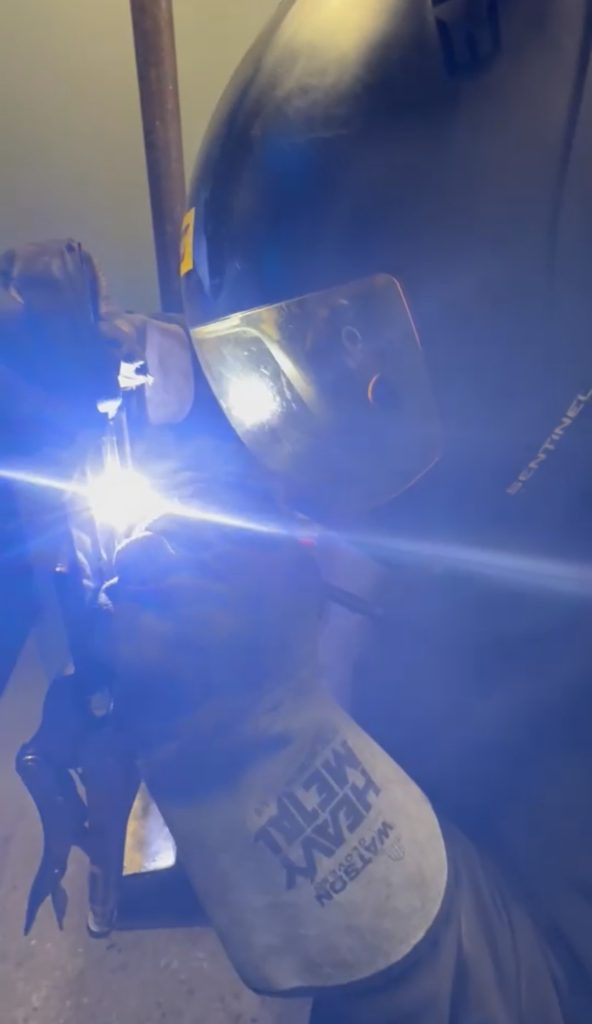
Personal Photo (2026).
The entire reason I decided to focus on the GTAW process is actually quite simple, I enjoy it. I have found myself evolving day after day of using the process in shop, learning new ways to control my bead, figuring out little cheats to increase the finished product, and I often find myself going back to TIG when I feel my other welds are underperforming or lackluster. Not to say I dislike the other processes I have come to know, I just deeply enjoy the slow and methodical pace TIG welding has to offer.
The topic of TIG welding to me is quite important, as SO MANY industries today use it and we go by without even thinking about how much effort has gone into producing some of the products we use every single day. Some products that we do not even realize are possible because of this amazing process. I will go into these applications more later into the project. But for now I should familiarize the reader with a few basic terms I will be using throughout.
There are quite a few specialized terms I will repeatedly use in the following pages, and it would be easier to have a centralized glossary so I do not have to explain each time what these terms are. Any terms not listed here I will explain when they are brought up in later pages. These are just some very basic terms that will be good to know.
TIG stands for Tungsten Inert Gas
Gas Tungsten Arc Welding
An atmospheric gas that does not react with oxygen to form impurities
The piece or pieces being welded
a metal wire or rod that conducts electric current to create an electric arc
Extra metal manually fed into the weld pool to add strength and volume.
A highly refractive metal that can retain its inherent hardness while red hot. This is what The T in TIG and GTAW is.
Lets go ahead and proceed to the next page where I will go over the history of GTAW and explain how exactly it works.